Dispatch 9
I am standing in a kitchen with a small group of people. The ceiling is low and the room feels cramped, although that probably has more to do with the people than the space.
A large wood cookstove, likely cold for decades now, fills one side of the room. Beneath it is a gigantic slab of stone. How did anyone get that into this building?
As the guide talks, I look around. Large containers, now empty, line the shelves: tea, baking soda, crackers, shortening. They hold the same kinds of things I might find in my kitchen, only in quantities I can hardly imagine. The Shakers fed far more people than I do.
I do not know as much about the Shakers as I would like. This visit is an unplanned stop on a Sunday drive, and I have arrived carrying a misconception.
I have placed the Shakers in the same mental category as the Quakers, Amish and Mennonites. From there, I have assumed they resisted modern technology and clung to older ways of doing things.
In this dark, low kitchen, I learn that I am wrong.
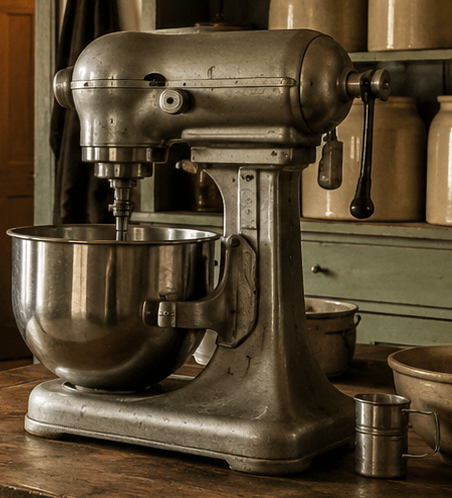
Sometime early in the twentieth century, the sisters at Canterbury acquired a KitchenAid mixer. As I remember the guide telling it, they loved the machine so much that one of the women wrote a poem about it.
That detail delights me.
Why did an electric mixer inspire a poem? What did it give them beyond mixed ingredients?
The tour moves into the dining room and dormitories. I try to stay present with the guide, but I keep returning to the KitchenAid. Why does their delight surprise me so much? Why is it difficult for me to fit a modern appliance into my idea of a simple life?
In the laundry, I encounter more evidence of Shaker innovation. Leather belts in the basement once powered machinery used for washing. Upstairs, large drying racks, almost like movable walls, could be shifted to improve airflow around the clothes.
Near the end of the tour, we enter a room filled with electrical appliances. I am amazed. These machines belonged to the same community as the Shaker man who painstakingly cut, numbered and moved the granite paving stones used throughout the village.
The machines did not replace care or skill. They existed beside them.
That is the part I have been missing.
The Shakers believed in creating heaven on earth. I do not yet know enough to say exactly what that meant to them or how they lived it. I can only approach the idea through my modern lens. Still, I begin to wonder whether the KitchenAid and the other innovations gave them something more valuable than convenience. Perhaps they returned time and strength to the people who used them. Perhaps they made more room for worship, music, art, fellowship or rest.
As the tour ends, I walk back to the truck and continue my Sunday drive, thinking about simplicity, passion and the things that make life feel full.
I have believed that a simple life might require hardship and the rejection of technology.
Maybe I am wrong about that too.
Maybe the right tools do not pull us away from the life we want. Maybe they help us make room for it.
New to Barn Owl?
 Barn Owl Exploration