Dispatch 23
I can’t begin to count the nights I’ve spent staring into a campfire, contemplating the flickers in the coals. Or the meals I’ve cooked, the coffee I’ve brewed.
For many years, I’ve heated my house with fire in a wood stove. Kettles of water have simmered with orange peels, apple peels, cloves or cinnamon to provide humidity and a pleasant smell.
From Thanksgiving until Valentine’s Day, we eat dinner by candlelight. The soft glow in a prematurely dark house comforts me. I think I feel a bit of a kinship with a light that bounces around rather than staying steady in the glass globe provided for it.
I once drove through a recently extinguished part of a forest fire. There were still little flames licking at blackened trees. The ground was black. Rocks were scorched. It’s hard to describe how that felt. Eerie is a word that comes to mind. Surreal is another. Today, nearly two decades later, the burned trunks still reach for the sky, although low, shrubby growth covers the ground.
It reminded me of a barn fire not far from my house when I was young. One day there was a barn, then it was gone. Decades later there is still just a very large concrete slab, now covered in bramble, where the barn had stood.
Fire is a funny thing. Our best friend, our worst enemy.
An article I read recently said that evidence of humans regularly using fire goes back around 400,000 years. To put that into perspective, that was before Homo sapiens arrived on the scene. It’s a fact that makes me wonder, was Prometheus a Neanderthal?
I’m thinking about fire because today I am researching a technique that is new to me. I have been asked to build a bed. The bed needs a finish. When I asked about the desired finish, I was told they want it burned.
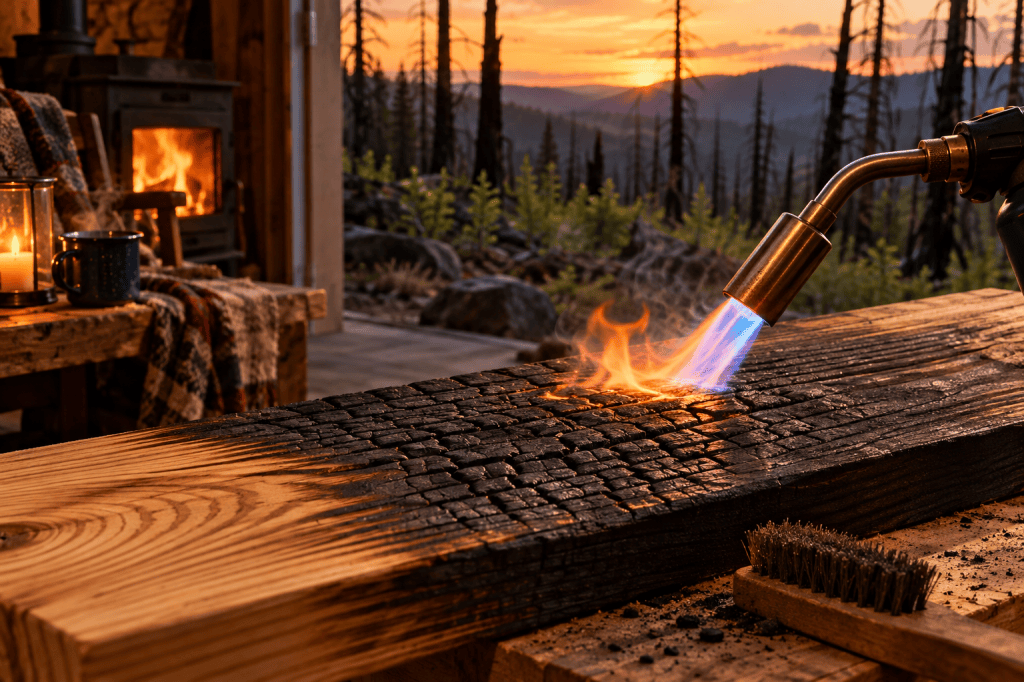
This idea is not entirely new to me. I’ve heard a little bit here and there. Yakisugi, often called Shou Sugi Ban in the West, is an old way of preserving wood. ‘Sugi’ is the Japanese word for cedar and the technique originally used Japanese cedar boards. The boards were formed into a triangle and a fire was lit at the bottom. The fire charred the boards.
The effect varies based on how deep the char is. A deep char of a few millimeters can produce an effect that looks similar to alligator skin. For exterior use, the char can be left intact, sometimes with an oil finish. For the bed I am making, I will brush off the carbon and soot before sealing it so that bed fabrics don’t become stained when they brush against the finish.
It might seem like burned boards would not be very useful, but the opposite could be possible. Traditionally, the technique was used to help protect wood from weather, insects, and even fire. Modern research hasn’t always found this to be true. Still, it is interesting that people discovered a way to use fire to change the properties of wood, sometimes making it more resistant to the very thing that changed it. Maybe this shouldn’t surprise me since a backfire is a way of fighting a forest fire.
Since this bed won’t be made of cedar, it won’t be traditional Yakisugi, but it turns out the technique can be used on other species as well. I will be trying it on southern yellow pine.
I wish I could say I’d love to stay and chat, but I’ve got to go find a torch.
New to Barn Owl?