Dispatch 20
In my shop there is a pile of lumber. It’s small lumber, most of it no more than an inch thick and a few inches wide. The ends are painted with blue paint. There’s a little bit of oak and some pine, a couple of pieces of pecan and three little boards that came from a plum tree.
Today I am standing among the trees. I’m actually in my back yard. It is cooler here than in the sun. There is a thick odor of pine.
In this part of the yard there are pine trees. Some of them are rather large and some are fairly small. They didn’t just grow here by themselves. Someone planted them.
From where I am standing, it’s a little hard to tell, but if I walk down to the end of the driveway it becomes obvious. Looking up the driveway and through the trees I can see that they are all in rows: up and down, side to side.
I have to wonder when they were planted and for what purpose. The age mix makes me wonder as well. They were not all planted at once, even though they are all in rows. Old stumps under the pine needles may offer a clue. Maybe the younger ones were planted when the older ones came down.
There is a problem with these trees. Looking back at the trunk nearest to me, I can see that there are odd “growths” sticking out from the trunk here and there. They aren’t really growing from the tree. They are the empty shells left behind by molting cicadas. As frightening as these large exoskeletons look, they are not the problem with the trees.
The problem can be traced to the small holes in the bark. The tiny holes don’t look like much, especially on this large tree, but they are the hallmark of bark beetles. There are several different kinds of bark beetles here and it’s possible that all of them are hanging out in these trees. They take advantage of trees that are stressed, in this case likely by drought. They enter through holes they make in the bark and lay eggs.
The eggs hatch and the larvae feed just beneath the bark, damaging tissues that carry food through the tree. Eventually, they can eat enough that the tree can’t get the nutrients it needs to survive.
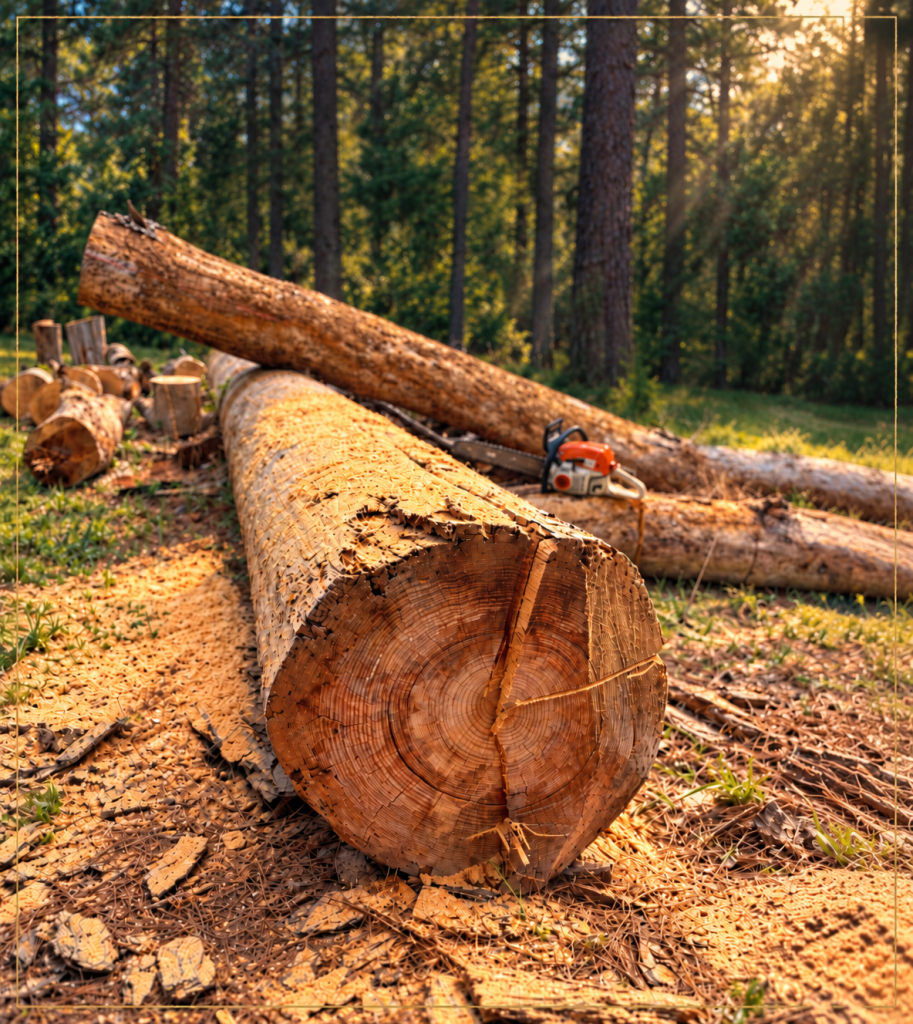
While a beetle infestation doesn’t always kill the tree, something has killed many of the trees in my yard. I have about twenty dead standing trees. I have been slowly removing them with my chainsaw.
I don’t particularly like to burn pine in the wood stove, so that leaves me with a lot of timber to do something with.
I also don’t want to leave the trees lying in the yard. So I turn them into lumber. Using the chainsaw, I cut the trunks into manageable pieces, usually about two feet long. I cut the rounds into four-inch slabs. Four inches is kind of important since it’s as thick as my table saw can handle.
That’s the next part. I run the slabs through the table saw to square them up and cut them down further so they are about an inch thick.
I paint the ends to slow the drying process which helps keep the wood from cracking and twisting. Then I let it sit around for a couple of months. Once it’s dry, I can further trim these pieces down to whatever size I need for the little projects I do.
It’s not the best way to make lumber, but it works. I like to think that these trees who have kept me cool on hot days get to have another life as a picture frame or a toy instead of just decaying back into the ground.
But for now, it’s hot and I’m going to head back to the garage. I have a pile of sticks to pick up.
New to Barn Owl?