Dispatch 7
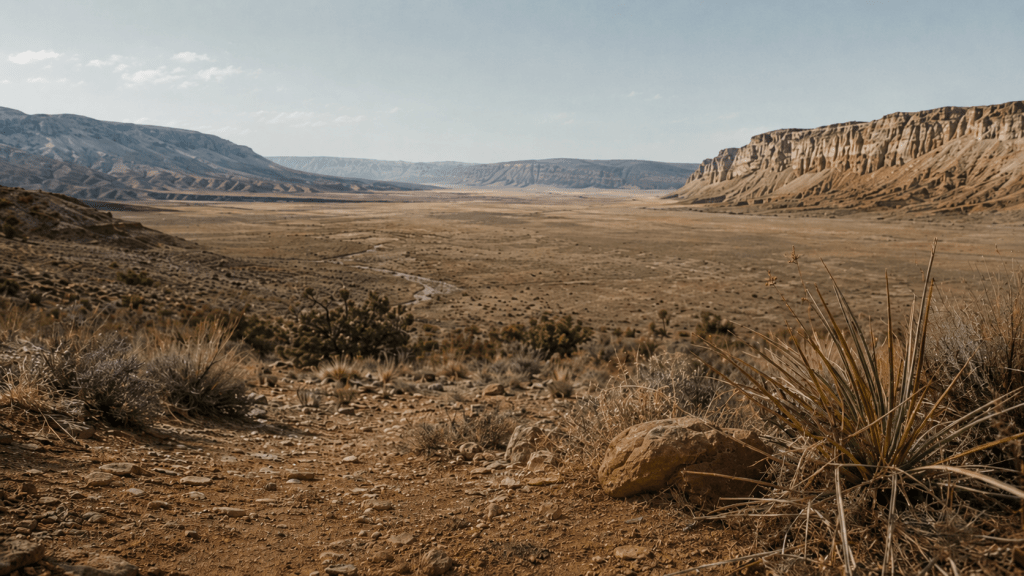
I stand in the middle of a giant stretch of open land. I have no idea how many acres of flatness surround me.
In the distance, both north and south, canyon walls rise up to contain this valley. Even to the west there is a barrier.
Rumor has it that I’m standing on deep layers of salt. Below the sand and dirt that cover this spot lie salt deposits that were left at various times by ancient seas or seawater. The water entered restricted basins, evaporated, and left salt behind. At least, that’s what I’ve read.
This scenario is a little hard to imagine, standing here and looking around me. My skin looks like it belongs to an alligator. My nose has the familiar stiffness that is brought on by the dry air. And I’m surrounded by dry dirt, hardly a drop of moisture to be found.
The desert plants have hard, waxy or spiky leaves, an adaptation to the climate, I suppose. They give up very little moisture. It’s hard to think that this area was covered with water. And it appears this happened more than once. Geologists say it has happened several times through the millennia. I am still trying to picture it.
I know there is a river west of here but it was not the river that made this valley. I am familiar with landforms carved by rivers, the motion of the water carrying softer sediments until the river itself sits at the bottom, surrounded by walls.
This valley is different. There is salt under the ground. I’ve heard it could be thousands of feet thick. The salt appears to be a major reason this valley exists today. Geologists say that salt under pressure behaves a bit oddly. I imagine it a little like what happens when you squeeze an inflated balloon and the air moves away from the pressure. The analogy is not quite right but maybe it’s similar?
Regardless, at some point the salt moved. As the valley fell, did the walls push up? Did the salt move somewhere else, allowing the upper layer to fall to its present altitude? Is it all still there, just distributed differently than it was? Or did some of it move away, maybe dissolved in groundwater?
Why are there walls around the valley? Are they made of different rock than the valley floor? Did it happen all at once or did it move so slowly that no living thing could detect the movement?
I wonder what it looked like here after the water receded the last time. I wonder if anything I’m standing on was once seafloor? Was the shape of this place completely different then? Will this be an inland sea again, sometime far in the future?
I look at the ground beneath my feet. I guess below the dirt and sand I can see lies all that salt. Is it stable now? Is the valley done being shaped? Maybe I should be a little nervous but I’m not.
Not far from where I stand I can see a dry wash making its way across the valley. Here is evidence, at least to me, that water is still shaping the surface of the valley, even if the valley itself was shaped in large part underground.
I glance beyond the dry wash to the expanse of the valley, then up to the mountains to the west. It is a little mind-boggling to me that a place that looks so dry, still and simple has been shaped by salt, pressure, and other things I cannot see.
I begin to walk, taking one more look across the valley. Somehow, it seems more interesting than it did before.
New to Barn Owl?
 Barn Owl Exploration